
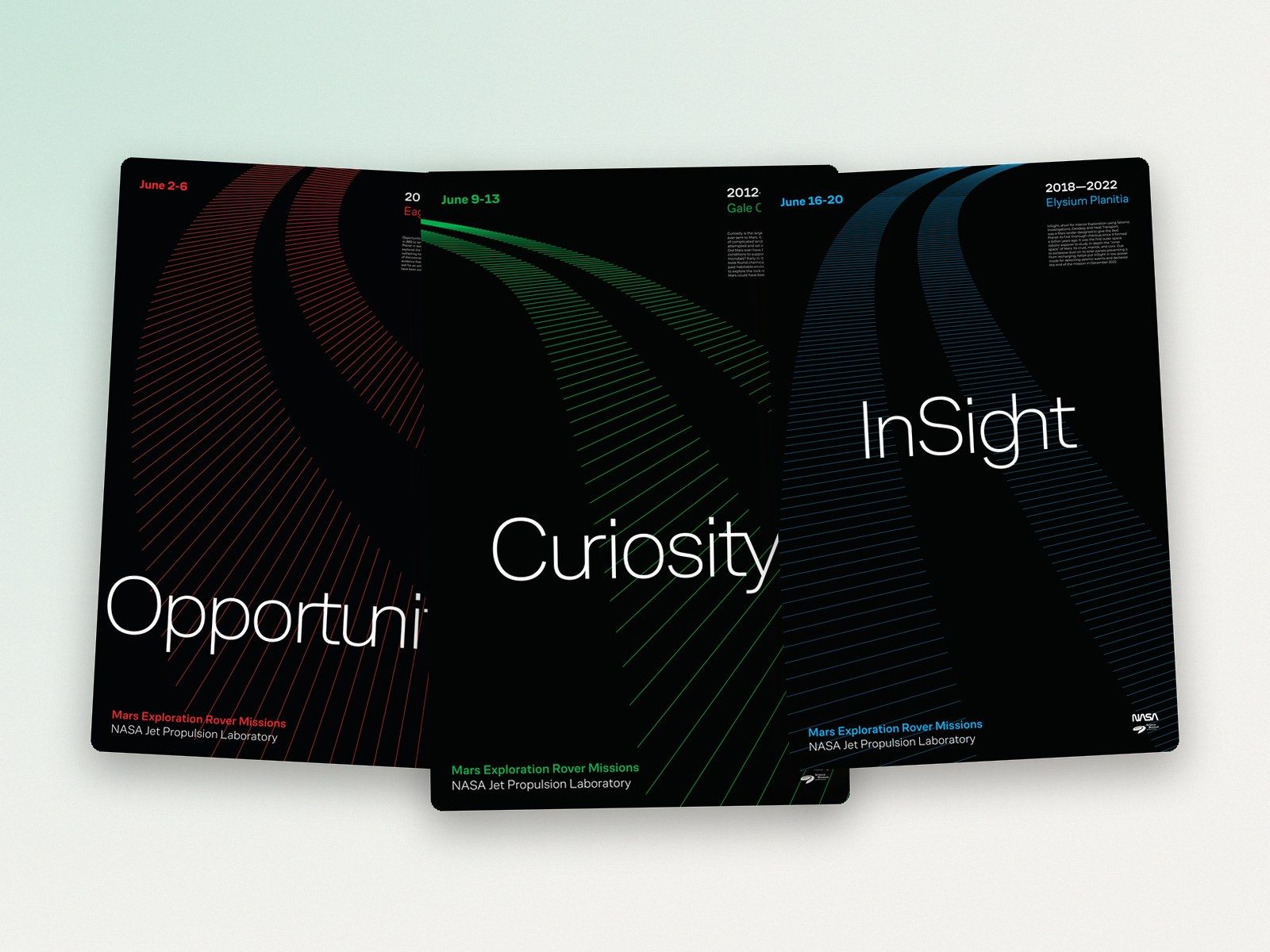
Three posters, one series.
Opportunity, Curiosity and InSight, each told through the tracks it left behind.
The three printed posters on the wall.
Closer.
At an angle.
At an angle.
At an angle.
The poster printed small and large.
The large print.
Opportunity explored the Martian terrain for almost 15 years, far beyond its planned 90 days.
The largest and most capable rover ever sent to Mars.
A lander built to study the “inner space” of Mars: its crust, mantle and core.
A mockup of the series at a bus shelter.
The final series printed and pinned up, April 1.
A series of posters for NASA’s Mars missions. It started with research: on March 13 I presented what I found about Opportunity, Curiosity and InSight.
What each one set out to do, where it landed and what it found became the content of each poster.
Our team was assigned the rover series, while another team focused on women in NASA. The goal was a unified visual system: consistent grids, type hierarchy and visual elements, so each poster stands on its own and still feels like part of a larger collection.
- Class
- Typography Lab 2, Loyola
- Professor
- Scott Gericke
- When
- March 13 – April 1, 2025
- Made
- Three printed posters
- AI use
- None. Every poster is my own design, from the first sketches to print.
How it came together.
The process in seven steps, one image from each. Hover or tap an image for the note.
The project opened with research on Opportunity, Curiosity and InSight, shared with the class as a presentation.
Concept sketches for Opportunity: three ideas, each with sketches and visual references.
Black and white only, on a grid of four columns by six rows.
Round 2: a black track shape first, then two colours.
Round 3.
Round 4: the poster extended into a set of three, with exhibition dates, in two versions.
The final set was picked through what resonated most in critique with my peers and Professor Gericke.
Picked in critique, printed April 1.
The final set was chosen in class critique, then printed and pinned up as a series. The project helped me think critically about working within a team style guide while still bringing my own design voice to a larger visual system.